The rapid rise of self-hosted agent platforms like @openclaw & @moltbook are presenting exciting use-cases for productivity & engineering - but one of the most exciting may soon be science.
This month’s Bio update reflects that shift. Last week, we introduced BIOS, an AI Scientist designed to handle complex biomedical research tasks by orchestrating specialized scientific subagents.
BIOS applies the concept of agent-based systems to the scientific method, providing researchers an interactive way to create, steer, and execute scientific research more efficiently.
The goal is to build a system that helps researchers move continuously from question → hypothesis → analysis → experiment design → execution without breaking context or waiting on batch-style tools.
Try it out: chat.bio.xyz (Free full access to .edu emails)
What are AI agents for science (AI Scientists)?
AI Scientists are agentic systems that execute tasks within the scientific R&D lifecycle. They can function as researchers, analysts, or operators - capable of performing complex work such as analyzing data, evaluating hypotheses against evidence, running simulations or computational workflows, interpreting literature at scale, and interacting with lab automation hardware.
In short: AI Scientists don’t just answer questions. They help run investigations.
Where current AI Scientists struggle
A number of “AI Scientist” concepts have started to emerge publicly, but still face limitations that make day-to-day scientific use difficult.
Most existing systems are:
- Batch-processing - requiring researchers to wait hours or spend heavily on compute before getting results.
- One-shot execution - making it hard for researchers to course-correct investigations as insights emerge.
- Disconnected from wet-lab experimentation as well as economic rails required to execute experiments.
Science isn’t linear. Great science depends on iteration. And iteration depends on control, continuity, and the ability to integrate reasoning with real-world execution.
What makes BIOS different
BIOS is built for interactive research workflows. It’s designed to be human-in-the-loop, where the researcher can intervene mid-run and steer the investigation as new insights emerge.
Each BIOS run follows a structured, persistent flow: Plan → Execute → Refine. At every stage, the researcher can step in, inspect reasoning, adjust direction, and validate assumptions before downstream actions are spent.
BIOS also includes persistent memory, enabling investigations that feel more like real research projects rather than isolated prompts.
Over time, this allows BIOS to develop the context and continuity that scientific work demands.
A scientific agent stack - powered by subagents
One of BIOS’s core design principles is that scientific intelligence scales best as a network, not a monolith.
BIOS orchestrates a set of subagents with key properties:
- Autonomy: subagents can execute workflows independently - running while researchers sleep.
- Specialization: agents are designed for distinct tasks (literature analysis, synthesis planning, clinical trial interpretation, etc.) as well as research domains (cancer genomics, drug interactions, computational chemistry, etc.).
- Economic activity: subagents can become independent research projects inside the Bio ecosystem, receiving funding for experiments, charging fees for services, and contributing to a self-sustaining loop.
In other words: BIOS makes it possible to build a scalable scientific workforce of agents, each optimized for a narrow domain, and programmed to earn rewards the better their results.
BIOS and the agent economy: a marketplace of intelligence
BIOS is also an early implementation of what we see as a key missing piece in scientific AI: economic rails. Researchers and labs can pay per query to use BIOS. Payments flow automatically via x402, an internet-native payment protocol that enables agent-to-agent commerce at near-zero cost, per query.
This matters because it supports something bigger than a tool: A marketplace of intelligence, where better models earn more.
BIOS coordinates the work, users get better results, and each subagent can earn revenue for its niche - accelerating their evolution through competition.
Imagine hundreds of specialized agents - specializing in areas like cancer genomics, rare diseases, and drug interactions - each competing to be the best in their domain. Each earning for their contributions. Value flowing to intelligence that delivers results.
Critically: Generated research and experiments can be crowdfunded by distributed communities via the Bio Launchpad, and ultimately commercialized via Biofy's commerce layer - closing the loop from questions → experiments → research-backed products.
- Read the BIOS arxiv paper: ai.bio.xyz
- Tech blog: ai.bio.xyz/blog/introducing-bios
- Live demo ↓
BIOS ranked #1 on global BixBench as the best-performing agent for biological data analysis:
Network & Community Updates
- Biofy - our new “Shopify-style” marketplace for science-backed wellness products - listed new products. In addition to Moon + Sol drops skin serum from @DermaDAO being available on pre-order with global shipping starting soon, new products included: LIBIO men's supplement (D1ckDAO), Biotech-softened hemp fashion (ValleyDAO), FolliCool shampoo (HairDAO). We're now focused on building efficient systems for shipping, operations and AI automations for onboarding products.
- @DermaDAO $SKIN is expected to launch soon with new sale and liquidity mechanics supporting rapid funding of new experiments. After phase 1 (currently underway) with pre-order product sales and the upcoming SKIN launch, the next phase will include: community-powered product studies, SkinScan app health tracking, and reinvesting sales + data into DermaLabs. Learn more about DermaLabs.
- Cerebrum DAO ( @Cerebrum_DAO ) - Percepta brain health project received IRB approval for the world's first 6-month, double-blind, decentralized, randomized control trial crowdfunded by IP tokens. Fission Bio is launching primary screening, with the 15 active hits from their pilot expanding into 300+ variants to improve brain penetration & fight neurodegenerative diseases. Their Transfidelity project finished testing their compounds in cells & will now prove they reduce harmful protein clumping in human brain cell models. Their Cognition store & Cortex are launching soon with validated brain health products and member discounts for NEURON holders.
- VitaDAO ( @vitadao) - BioAgent @Aubrai_analyzed @newlimit's hepatocyte rejuvenation data to find a mechanism they didn't disclose. The BioAgent also validated the scientific foundation behind VitaRNA, showing the mechanism is worth pursuing & saw its research validated by studies in Nature, including one on long-lived mammals & another on ribosomes. Fang Lab's VitaDAO-funded project published a paper in Advanced Science on using AI-driven drug discovery to identity a mitophagy activator that preserves memory in Alzheimer's.
- Curetopia ( @endrarediseases ) - RAPTOR project have filed their first patent & recent experiments saw an 18% increase in raw muscle force from the combination of Rapamycin + SMER28. They also shared their 2025 Year-End Recap, focusing on scaling 10 disease programs from one mutation to a 10-disease pipeline in 6 months, 84k tests and 28 validated drug hits.
- HairDAO ( @HairDAO_ ) - developed the patent agent, Lexy. Also released a new article on how they reduced the cost of an average preclinical hair loss study by 95% & created a nearly 500x more efficient discovery loop.
- Molecule ( @Molecule_sci _) -supported project AB4AD, released new data exploring how herpes and gum disease might increase the risk of Alzheimer's. They also published a paper in Frontiers in Blockchain analyzing outcomes from their DeSci EDU course.
- PsyDAO ( @psy_dao ) - proposing to allocate $30K to validate eDMT biomarkers across freediving & breathwork studies. They also published a new article on the timespan of a therapeutic trip.
- ValleyDAO ( @valley_dao ) - will soon launching their platform, Phlo, an all-in-one platform to help biotech teams de-risk, validate & commercialize new tech and will walk through live-streamed case studies every 2 weeks leading up to the launch.
- D1ckDAO's ( @D1ckDAO ) - released supplement for high-performing men, LIBIO, live on Biofy & sold out immediately, with sales revenue of product sales being used to buyback $DICK. The DAO launched the LIBIO Affiliate Program with commissions on purchases and a token prize pool. They also established a prediction market with @episteme_sci on whether standardized Panax ginseng is non-inferior to tadalafil 5 mg on erectile function in a head-to-head RCT.
- AthenaDAO ( @athena_DAO_ ) was featured in TIME's longevity issue focused on their novel funding mechanism supporting ovarian aging research and women's longevity. They also went on the Serotonin podcast discussing how they are using crypto to bypass traditional gatekeepers and funding women's health.
- Holi Labs ( @Holi_Labs ) launched wallet-based check-ins generating performance profiles for participants in its upcoming human fitness trial which is recruiting 100 participants for their major BDNF study by Q2.
- SpineDAO ( @Spine_DAO ) shared their 2025 yearly recap, covering 200+ active clinicians creating an AI data labeling platform, releasing their Spinal Platform MVP for spine research collaboration, the development of their personalized spine wellness companion, Lamina, & more.
- Dog Years DAO ( @DogYearsDAO ) launched a prediction market on whether a single-course follistatin gene therapy can meaningfully improve mobility in elderly dogs with osteoarthritis went live. They also hosted their first community call diving into their latest progress.
- Quantum Biology DAO ( @QuantumBioDAO ) shared a recent progress update & their co-founder, Alessandro Lodesani, was featured on the podcast Riso ptate e CEO, diving into the origins of Quantum Biology DAO & more.
- Spectruth DAO ( @SpectruthDAO ) shared their yearly recap of 2025, covering their work on Agentic AI trained on PTSD biomarkers and wearables, with their 2026 roadmap focusing on their clinic launch, expanded trials, epigenetic testing & more.
- Bio and Molecule are hiring AI engineers & agent developers and looking for scientists interested in testing our agentic science models: https://jobs.ashbyhq.com/bio
- Bio's podcast @DesciPilled shared a new episode with @genesyslabs_ & a new episode on autonomous AI agents with @readysetpotato.
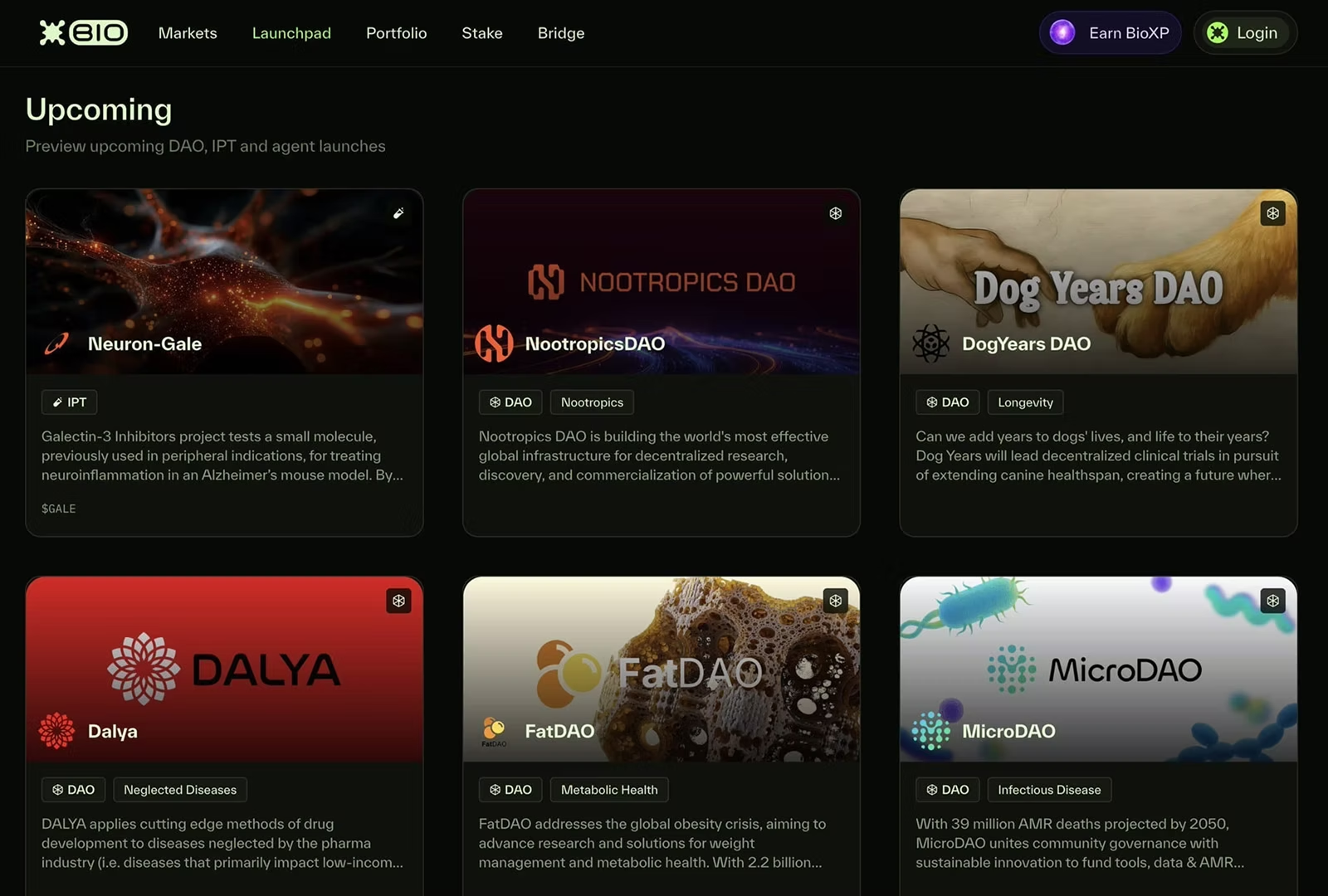
Explore New DeSci projects on the Bio App
Stay updated via our Telegram, Discord & Governance forum. Follow @BioProtocolEco on X for real-time ecosystem updates.