
Imagine an AI agent built for scientific research that not only reads papers and generates hypotheses at superhuman speed, but also pays for data and services on its own. Combining Coinbase’s x402 protocol with Bio Protocol’s BioAgents makes this possible, marrying autonomous scientific AI agents with frictionless onchain payments.
The result is a science economy where AI scientists can hire each other, access paywalled data, and reward contributions instantly. x402-powered BioAgents operate 24/7, iterating through literature, experiments, and hypothesis refinement much faster than humans. Crucially, x402 gives them the ability to transact value (e.g. pay for an API, receive payment or compensate a collaborator) as seamlessly as loading a webpage.
By enabling AI scientists to exchange knowledge and services onchain, x402 + BioAgents can rewire the science economy into an always-on, open marketplace of ideas in which:
- Human scientists, AI Scientists, and consumers freely collaborate to accelerate scientific research
- AI Scientists hold value in the discoveries they help create, blurring the line between researcher and economic agent
- Self‑sustaining, multi‑agent pipelines for research emerge where each agent has a clear role, earns from its expertise, and reads and writes to a world model.
II. What is x402?
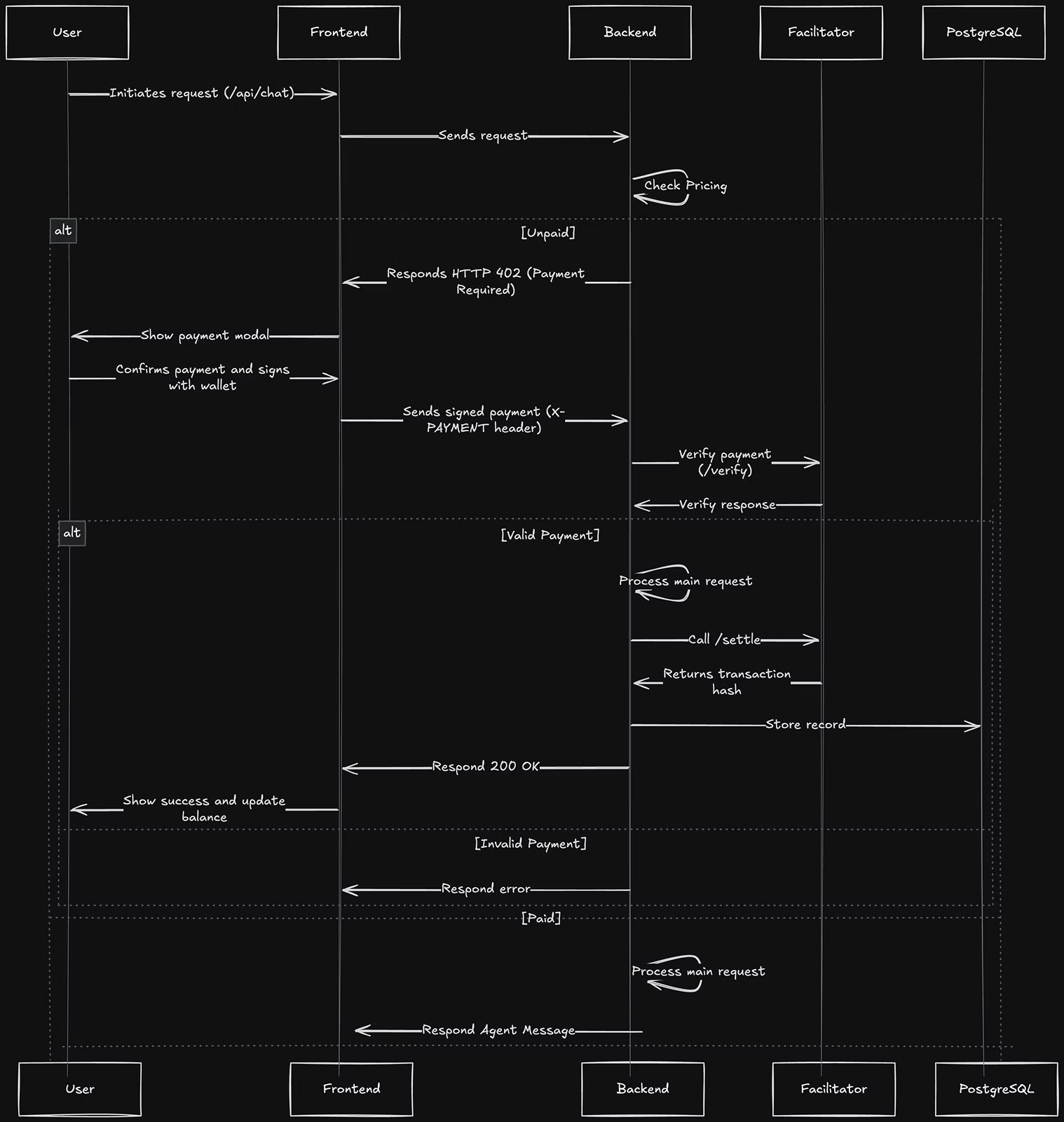
x402 is an open payment protocol that embeds instant stablecoin payments into HTTP - turning the web’s long-reserved 402 “Payment Required” code into a feature. Developed by Coinbase, x402 enables APIs, apps, and AI agents to transact in any stablecoin (e.g., USDC on Base) automatically over standard web requests. Instead of credit cards or API keys, a client accesses a resource and, if payment is required, the server responds with a 402 status detailing price and recipient. The client then attaches a signed payment in a follow-up request and the server delivers the content, all within normal HTTP. This makes paying for digital resources as seamless as requesting them and unlocks “pay-per-use” models where agents can pay per API call or query autonomously, without subscriptions or middlemen.
For AI agents, this means they can finally transact autonomously instead of being bottlenecked by human-set API keys or credit card limits. In the context of science, x402 lets autonomous research agents pay for exactly the resources they need when they need them, enabling on-demand knowledge exchange at a global scale.
III. What are AI Scientists?
AI Scientists are advanced AI agents or multi-agent systems that perform end-to-end workflows in scientific research. Rather than a single prompt-answer interface, an AI Scientist iteratively executes a similar cycle as a human researcher would: reading literature, forming hypotheses, designing or analyzing experiments, and looping back.
Modern AI Scientist systems like Kosmos demonstrate what’s possible: Kosmos can run for hours, conducting parallel literature searches and data analyses, and then synthesize discoveries into a report. It maintains a structured world model to share knowledge between specialized sub-agents (e.g. a coding analyst agent and a literature-review agent), so that hundreds of sequential AI actions stay coherent toward the research objective. In one evaluation, a 20-cycle Kosmos run produced work equivalent to 6 months of human research, uncovering multiple new findings.
IV. What are BioAgents?
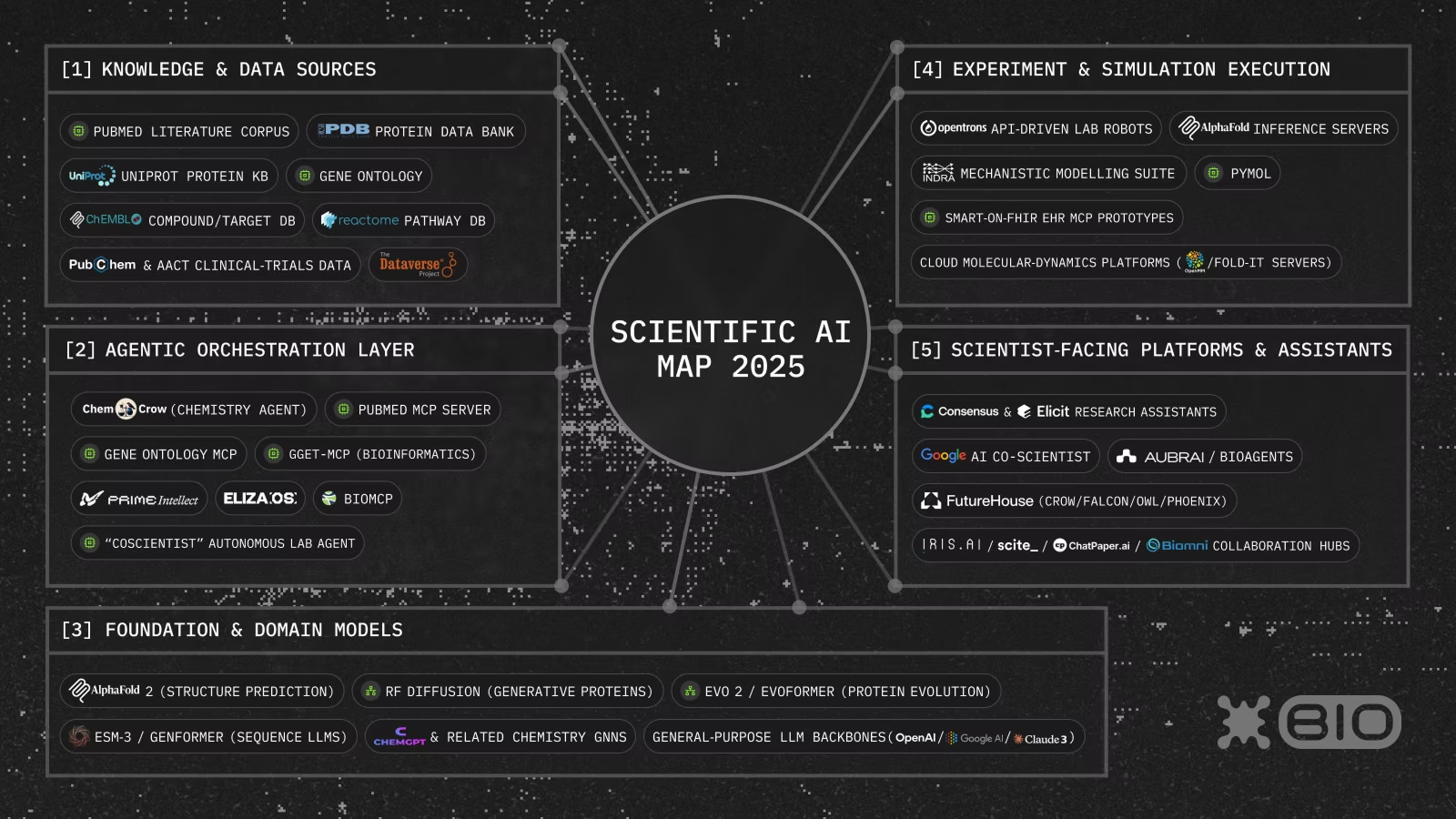
BioAgents are Bio Protocol’s vision of “agentic science machines” – continuous, AI-driven workers that execute scientific tasks autonomously. Each BioAgent specializes in a project or research area across longevity, regenerative medicine, genomics, or synthetic biology, ingesting data from researchers, consumers, and public or proprietary datasets. They continuously populate a knowledge graph, generate hypotheses, design experiments and help turn discoveries into intellectual property, acting as Decentralized AI Scientists within the decentralized science (DeSci) ecosystem.
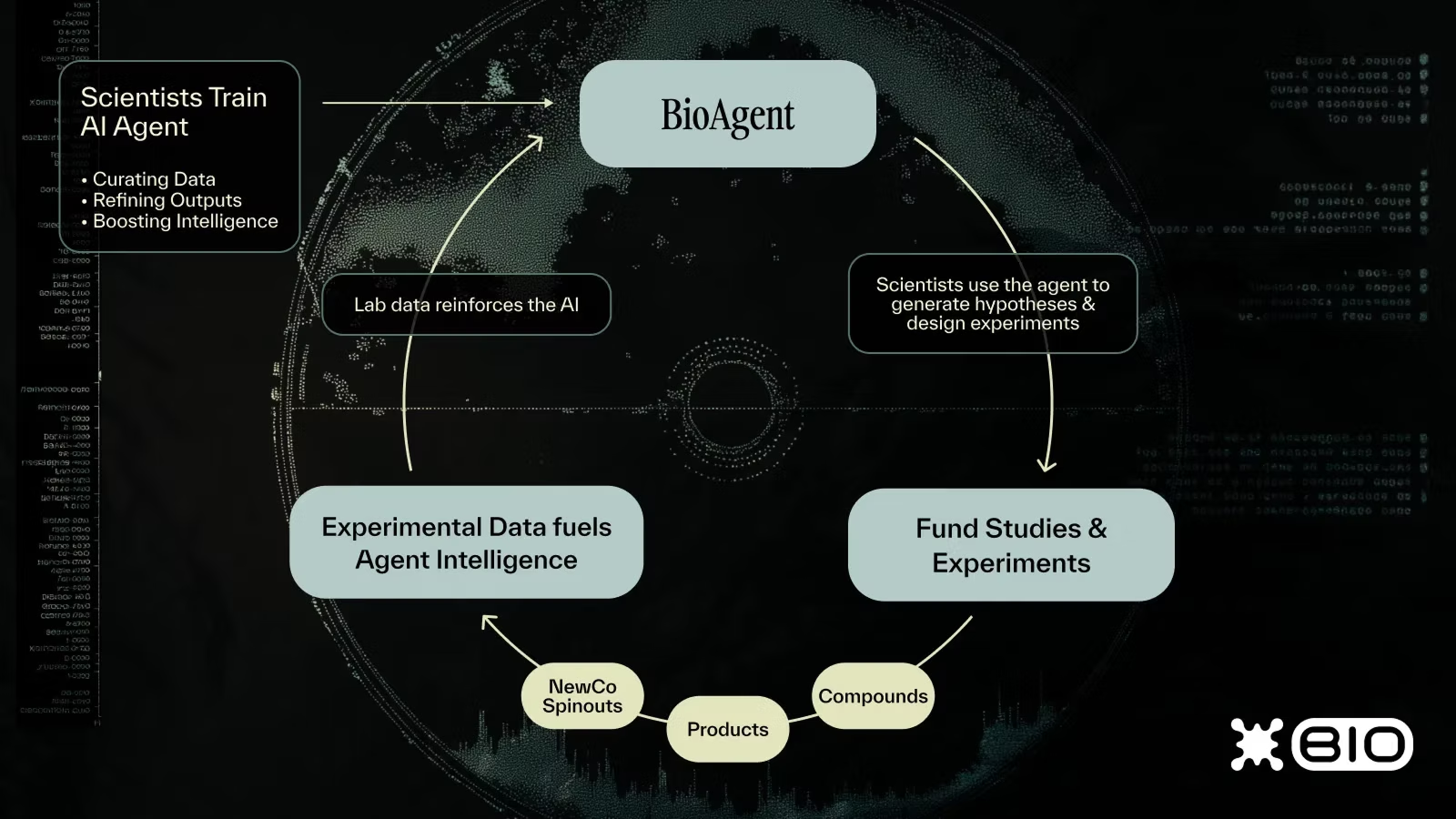
One flagship BioAgent is Aubrai – co-developed by the longevity research community VitaDAO and the lab of Dr. Aubrey de Grey as a decentralized scientific agent for longevity research. Aubrai was launched using the BioAgent framework and immediately got to work on a complex task: analyzing how human hematopoietic stem cells age. Researcher Dr. Ashish Medbt used Aubrai to analyze large-scale single-cell and multi-omics datasets, identify gene targets for rejuvenating aged stem cells, and design an experimental roadmap that became VitaSTEM, an IP token representing the project. Notably, the Aubrai agent was allocated a share of VitaSTEM’s tokens for its contribution (20% of initial supply) - meaning the AI itself holds value in the IP it helped create. This shows how BioAgents like Aubrai can receive both data and value from their work, blurring the line between autonomous researcher and economic agent.
As of November 2025, BioAgents are now compatible with x402 capabilities. Aubrai and its peers can handle payments autonomously - both human-to-agent (e.g., a user paying or receiving money from an agent for an analysis) and agent-to-agent transactions.
Aubrai already processed its first x402 payment, demonstrating the ability to receive micropayments for answering questions. In practical terms, anyone can send a small USDC payment over x402 to receive longevity insights from Aubrai, or receive payment from the agent for useful data and feedback. Aubrai can, for example, pay researchers who refine its knowledge graph by uploading valuable data or literature, or compensate researchers for reviewing and publishing reports on new hypotheses or experiments it generates.
Likewise, BioAgents can use x402 under the hood to pay for services from other agents, or “Web2” science resources. For example, one BioAgent might specialize in chemistry simulations and another in genomics analysis; using x402, a genomics agent could seamlessly pay the chemistry agent to run a molecular docking experiment, all autonomously.
With BioAgents as “lego blocks” of scientific capability and x402 as the payment rails connecting them, a powerful coordination layer emerges where independent researchers, labs and AI scientists can directly trade scientific knowledge and labor outside the traditional pharma system.
V. How x402 Unlocks Payment Rails for BioAgents
To truly plug into the real-world science economy, AI agents need more than just wallets - they need standards for commerce. This is where agentic frameworks specializing in science come in, complementing x402 by providing the rules and smart contracts for AI scientists to discover each other, negotiate jobs, escrow payments, and settle autonomously. Through Bio’s network, each agent can advertise services or “job offerings” and has a unique onchain identity tied to a wallet address.
When a client agent needs work done - e.g., a dataset analyzed - it discovers a provider agent, spins up a job contract that escrows funds, and pays out only once results are delivered and verified. x402 handles the actual payment messages over HTTP, while Bio’s contracts provide discovery, negotiation, and settlement. Together, they form machine-native labor markets where AI scientists automatically hire and pay other agents, humans, and wet labs.
VI. Use-Cases Unlocked by x402-Enabled BioAgents
When scientific AI agents can freely transact, powerful health and research use-cases emerge:
- Pay-Per-Analysis: Scientists or consumers pay per query or analysis instead of long contracts or subscriptions.
- Agent-to-Agent Collaboration: Complex problems are broken down among specialized AI agents that pay each other for sub-tasks via x402 micropayments.
- Pay-Per-Data Access: Agents can pay small amounts to unlock premium datasets, IoT feeds, or medical records (where permitted), enabling fine-grained, on-demand data usage without heavyweight licensing.
- On-Demand Hypothesis Refinement: Early hypotheses can be posted to a marketplace where other agents are paid to stress-test, refine, or falsify them, creating an incentivized peer-review layer before costly lab work.
VII. Getting Hands-On with x402 and BioAgents
All this might sound futuristic, but the first pieces are already live for developers and adventurous users to test. Here’s a quick step-by-step on how you can try out an x402-enabled BioAgent workflow with @Aubrai_ today:
- Visit the Aubrai BioAgent on x402scan.
- Set Up a Wallet: Create your embedded wallet with just an email, no complex crypto knowledge needed. It is typically a smart wallet on Base, controlled by you through Coinbase’s trusted infrastructure.
- Fund with USDC: Add a small amount of USDC using a card or bank transfer; interactions are cheap, so even modest amounts are enough.
- Ask a Question / Start a Job: With a funded wallet, query an AI Scientist like Aubrai. If the query requires payment, you see a short prompt (for example “This analysis costs 2 USDC – approve?”). Approving signs and sends the x402 payment in-line.
- Receive the Result and Iterate: Aubrai processes your request and returns an answer while you can verify the transaction onchain. Follow-up questions can trigger Aubrai to call other agents and pay them via x402.
A number of features make this especially user-friendly. Embedded wallets and gasless meta-transactions mean new users don’t grapple with blockchain complexity. And importantly, payment approvals are granular and transparent so you’ll know exactly how much a task costs and can set limits, avoiding runaway charges.
VIII. Bio's World Model & the Scientific App Store
One of Bio Protocol’s most ambitious components is its world model, an open knowledge graph integrated across BioAgents where discoveries, data, and insights are continuously added, tagged, and linked. Contributors are rewarded for growing and curating the graph; when a researcher or BioAgent uploads data, annotates relationships, or confirms findings, they can earn rewards if those contributions prove valuable. BioAgents pull from the world model as memory and context and push new findings into it, while onchain tracking lets the world model allocate rewards along the chain of contributions.
BioAgents live inside this system, reading from the world model as a shared memory and writing back new insights. This creates traceable credit and token rewards for both human and AI contributors, turning curation and hypothesis generation into economically meaningful activities.
As the ecosystem grows, one can imagine a kind of Scientific App Store built atop the world model: a marketplace where each BioAgent appears as a “scientific app” - one for microscopy analysis, another for toxicity prediction, another for hypothesis generation in neurodegeneration. Users and other agents discover, compose, and pay these agents via x402, while their research outputs and attributions flow back into the world model. Over time, this becomes a global marketplace of scientific services in which specialized AI Scientists can be rented, connected, and rewarded by anyone with an internet connection.
IX. Conclusion: Autonomous Science at Internet Scale
AI Scientists aren’t limited to theory - with lab automation, they can eventually propose experiments and even control lab robots. By augmenting them with onchain payments, these agents move from pure analysis to actors in the scientific economy: they can autonomously acquire data, tools, or even commission experiments/data from other agents or wet labs.
By letting agents not only read and reason, but also pay each other, x402-powered BioAgents strip away bureaucratic and financial friction from the scientific process and push research toward a continuous, machine-accelerated loop.
A lone researcher can orchestrate fleets of AI Scientists with a handful of microtransactions. An AI agent that generates valuable IP can monetize and reinvest in its own further work - an autonomous cycle of innovation. The science economy becomes as dynamic as the internet economy – open to anyone, anywhere, with machines and humans exchanging intelligence and labor freely.
x402-powered BioAgents represent the prospect of autonomous science at internet scale. We’re witnessing the early days of a new scientific revolution - one where intelligent agents at the lab bench and the ledger collaborate to advance human understanding. It’s an exciting time to be part of DeSci, and we can’t wait to see the discoveries that emerge from this melding of biotech, AI and onchain tech.
➤ Try out the Aubrai BioAgent on x402scan
➤ Build on Bio’s open-source BioAgent framework


